


From Imposter Syndrome to Forbes 30 Under 30…
What is it really like starting a media company from your bedroom? Tobi Oredein and her husband Bola Awoniyi have done just that by starting Black Ballad, a platform that tells the stories of Black British women in an authentic way.
I first met Tobi at a Nubian Skin event four years ago and held onto the embossed business card that she gave me. At that time I didn’t know that I needed a platform like Black Ballad. I must have binge-read every single article the first time I visited and loved the different kinds of perspectives that were offered.
I caught up with Tobi to find out about the early days and how it felt to be named on the Forbes 30 under 30 list. She’s also freelanced for The Pool, Buzzfeed, The Independent and Grazia, plus she’s spoken at Cambridge University.
There’s some magazines that I’ve had flings with and others that have been my long term loves. One of my most treasured possessions was the issue of Smash Hits with Britney and Justin on the cover. As I was raised as an only child, it felt like I was talking to somebody my age and I really loved that idea. By the age of 13, I’d made up my mind that I was going to be a journalist.
Cosmo Girl was probably the most important publication to my life. Looking back, it was a pretty toxic relationship because as much as I loved it, I felt so invisible as every girl featured didn’t look like me. I remember they once did a beauty feature with pale skin, medium skin and dark skin was olive. It just didn’t make sense. It sounds really stupid, but it was a bit of an amazing toxic relationship.
After graduating from King’s College with a degree in American Studies, I got my first job at a TV magazine. I was freelancing and doing celebrity gossip journalism and I just hated it. The role meant that I had to attend parties to get quotes and I’m really not a party person. I have no interest in what celebrities eat when they get home.
I used to constantly tell Bola (my then fiance, now husband) all the time that there’s nothing in the UK that I would even think about reading. When I was studying, I was so engrossed in America’s race relations and did essays on colorism and the racial identity of Barack Obama. I was also obsessed with Ebony, Essence, BET and all the American media platforms that were focused on black life. He kept saying ‘Why don’t you just make your own publication?’ but he would say it so nonchalantly.
Things only switched when I got turned down for an editorial assistant job. I called Bola and said I was going to start my publication for black women and that he was going to do it with me. I came up with the plan by the time he’d come home from work and everything was laid out. He didn’t really have a choice.


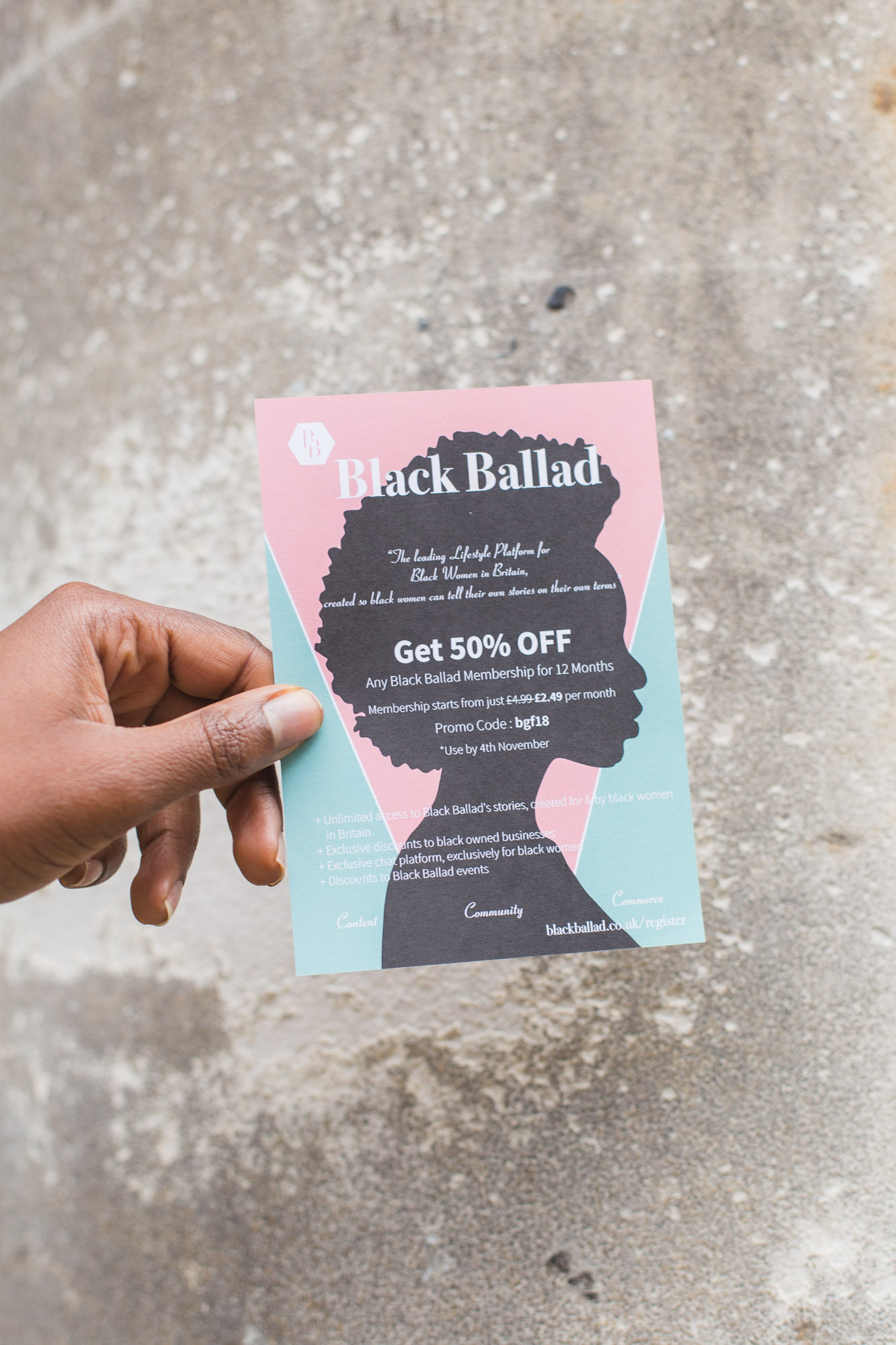

We launched Black Ballad in 2014 as a free access blog. I had no expectations, I just wanted to create a publication that fulfilled me as a reader and a writer. During the early days, I felt much more fearless. It didn’t feel like anyone was reading, I was just running everything from my bedroom and making things up as I was going along.
If I’m honest I didn’t have a business hat on at that time, even though we put all our savings into it. I’m really grateful for those days. By doing everything from the social media, to the editing, I was able to learn so much. It was a humbling experience as it made me see that the little things were as important as the big things. We had a small team and it helped me define who I wanted to be as leader and how I wanted people to feel.
I’ve always tried to make Black Ballad revolve around the first time experiences of black women. That way I’m not too bogged down with an age. It’s the black woman who might be entering employment for the first time and wants to learn how to navigate that world. It might be the black woman who’s running her first business, freelancing or buying her first home. She might be getting married or experiencing motherhood for the first time. Maybe she wants to change direction in her career.
Black women are not all the same. That’s why I’ve always thought that platforms like Gal Dem and Melan Mag are so important, because they’re reaching different audiences. It’s great that we can have choice. For instance we had a piece by a woman who’s thirty and tried lipstick for the first time. I thought that was really important. There’s this misconception especially with YouTube that all women regardless of race wear a lot of makeup. Even if that’s not your experience, it can remind you of the first time you tried lipstick and it may have gone horribly wrong.
The first time I realise that working with advertisers wasn’t an option was when I was recovering from an operation and we had the opportunity to meet with a beauty brand. I remember being in so much pain. I wasn’t really supposed to go out as I still had stitches in, but I wanted to take the meeting myself. They said ‘We absolutely love Black Ballad but as you haven’t launched, for something like this we’d probably go with a different magazine as they reach a larger audience.’ The product they wanted to launch was targeted at black women, but they still wanted to go with a mainstream magazine.
It felt like a slap in the face but I quickly realised that advertising is a pure numbers game. If black women make up 1.5% of the UK population, then I’m losing every time. I just knew that we had to figure out another way to make it work financially. That’s when Bola suggested the crowdfund. Back in October 2016, we decided to relaunch as a subscription-only platform and get at least 1500 members. We wanted to create a platform that makes the world a better place for black British women and tells our stories on our own terms. For me it was do or die. If it didn’t work, I’d just shut Black Ballad down and get a job.
The crowdfund started off really really slow. People said they’d contribute but it was so disheartening in the beginning. We’d also researched crowdfunding but didn’t look into digital subscriber numbers for magazines. Our target was 1500 subscribers but some magazines like Marie Claire and Look didn’t even have 500 subscribers. We realised that our target needed to be adjusted, so we lowered it to 250. If we didn’t get that number, we’d call it quits.
When we released the ‘Mainstream Media Cares More About Avocados Than Black Women’ video, I realised that we needed to be transparent. No one would give us press before that. It went viral and people still talk about it now, as embarrassing as it feels. I also did the BBC Black and British show and everything started to come together.
The last night of our crowdfund was one of the most emotional days of my life. We were still way off our target and the website crashed. I couldn’t get hold of our tech person and people were emailing me trying to buy memberships. I was in a state of panic. After two-and-a-half hours, the crowdfund website went back up and it felt like the longest period of my life. I just thought, I need to tweet for my life and make it work.
We pulled it off and I broke down again. I couldn’t believe it. Everyone tells you that nobody will pay for content. If you don’t pay for content, then how do the creatives get paid? I couldn’t keep asking black women to give their time, their talents and their emotional labour for free. It just wasn’t right.


I’ve had people write Black Ballad off as a little blog that’s just for black women. Yes we’re empowering women, but we’re also creating serious journalism. I see journalists who’ve written something really similar to a Black Ballad piece and the great thing about the membership is that you have to put your email address in to have access. I see so many big publications signing up and then soon enough, I see a similar article on their sites. Yet they would never pay me to be in their offices or consult. They just think it’s easier to come, take from my website and not give me credit. It can be really frustrating.
I’m very fortunate to have two mentors in Ronke Lawal and Sam Baker. Ronke gets the microaggressions and what I’m up against more. She was only meant to mentor me for a year but she’s not been able to get rid of me yet. Her words have really helped me with my self-belief.
Sam’s great at telling me how to navigate the industry from a business point of view. She’s so supportive. If she has a connection that I don’t have, she’ll just send them an email. I respect her and what she’s built and that as a white woman, she’s doing her best to create opportunities for other black women.
When Bola said we’d made the Forbes 30 under 30 list, I thought that he was lying. I’m not someone who wanted to start a business. I’ve always craved the stability of having a full time job and never really thought about success in the early days. When it started to come I was like ‘Oh, is this meant for me?’ Imposter syndrome is something I’ve definitely had to battle. Award recognition and money have come from more mainstream audiences and I’m often the only black face. You think ‘Am I really supposed to be here?’
It’s a journey and now I’m at a point where I can say that I deserve this. People congratulate me on Forbes and that’s amazing, but it’s been four years in the making. Forbes has been sleepless nights. Forbes has been, ‘Okay I’m going to order tap water at my friend’s birthday’ because it’s the difference between paying a bill for Black Ballad or enjoying a night out properly. Forbes has been, we’re going to sacrifice our mortgage deposit to make sure Black Ballad runs accordingly. Forbes has been, I’m going to pay black women but the only black woman that doesn’t get paid is actually myself.
Now it’s not even imposter syndrome anymore. I deserve this. I’ve sacrificed, I’ve worked hard, I’ve shed tears over Black Ballad. I’ve done everything I can to make sure that this functions as a profitable business. I also don’t want to be the person that has Forbes 2018 in my bio and then I never did anything else. People hang onto their achievements to stay relevant but if you haven’t done anything else, then what’s the point?
Find out more about Black Ballad free access and membership plans, plus Tobi’s other articles for The Pool, The Independent and Buzzfeed. In this series I’ve also interviewed illustrator Dorcas Magbedelo and MDMflow founder Florence Adepoju.

